
Parish Summary: Tilney St Lawrence (Taken from Norfolk Heritage Explorer)
This Parish Summary is an overview of the large amount of information held for the parish, and only selected examples of sites and finds in each period are given. It has been beyond the scope of the project to carry out detailed research into the historical background, documents, maps or other sources, but we hope that the Parish Summaries will encourage users to refer to the detailed records, and to consult the bibliographical sources referred to below. Feedback and any corrections are welcomed by email to heritage@norfolk.gov.uk
Tilney St Lawrence is a large parish situated in the West Norfolk Local Government District, and has an area of 2041 hectares. This parish contains the villages of Tilney St Lawrence, Tilney cum Islington and Islington. The name ‘Tilney’ is thought to derive from the Old English for Tibba’s homestead, and ‘St Lawrence’ refers to the dedication of the parish church. The name ‘Islington’ is thought to derive from the Old English for enclosure of Elesa’s people. The parish that we see today used to be two separate parishes; that of Tilney St Lawrence and Tilney-cum-Islington. In 1935 they were combined to form the fourth largest parish in the Marshland region.
During the prehistoric period the landscape in this area underwent several fluctuations, and it is likely that it was substantially different to the landscape we see today. Much of the land was only fully drained in the last two hundred years, and it is thought unlikely that occupation would have been possible during the prehistoric period. As a result the only recorded monuments are some extinct watercourses (NHER 21397). However, a Bronze Age hammer stone (NHER 2233) and an Early Bronze Age flint arrowhead (NHER 18545) have been recovered.
Despite this lack of early occupation the parish came to be dominated by two Roman canals. ‘Aylmer’ Canal (NHER 25333) has been traced for 5.6km, and examination of samples taken from it indicate that it passed through waterlogged silts or peat. ‘Spice Hill’s canal (NHER 25334) appears to run southwest to northeast and is likely to join the Aylmer canal, though it is a less obvious feature. Both are likely to have been used for communication and transport, but a marine inundation in the 2nd or 3rd centuries appears to have caused severe and permanent damage.
Fieldwalking has also identified a number of scatters of Roman pottery sherds. A group of these has been recorded in the west of the parish, just south of the modern Terrington St John (NHER 21415 and 21412). These include two noticeable pottery sherd concentrations (NHER 22418 and 22419), as well as one containing pottery sherds, bone fragments and some briquetage (NHER 21413). A small group have also been noted in the east, near Salgate Farm, and all but one (NHER 20317) are low density scatters (NHER 20318, 20314 and 20316).
There is also evidence for some occupation in the Early Saxon period. Fieldwalking in 1985 recorded a marginal settlement (NHER 21397), which at that time was the only Early Saxon site recorded in the Norfolk Fens. No other Early Saxon evidence has been recorded, and the nature of this early settlement is obscure. However, a small number of Middle Saxon pottery sherds have been recovered to the north of the parish, though all three sites are of low density (NHER 20313, 21377 and 22055). Late Saxon pottery sherds have also been recovered from three separate sites, though these are also of low density (NHER 20299, 20320 and 20321).
The settlement of Tilney St Lawrence does not appear to have existed in its own right during the Late Saxon period, for it is not listed in the Domesday Book. However the settlement of Islington, which lies in the very northeast corner of this parish, is listed. Today very little is left of Islington, and although fieldwalking has taken place nearby, the actual area of the settlement has not been investigated. As a result we have very little evidence for what must have been a populous and valuable Late Saxon settlement, with a number of salt houses and a church. This church is likely to have been the present day St Mary’s Church (NHER 2240), which lies redundant and largely ruined.
However, by the 13th century Tilney had overtaken Islington, and gained a church dedicated to St Lawrence (NHER 4475). The church was restored in 1846, but retains a number of Decorated and Perpendicular style features. Few other confirmed medieval features have been recorded, but possible trackways (NHER 21378), tofts (NHER 19108) and field systems (NHER 18545) have been recorded.
Occupation evidence for the medieval period is abundant, with pottery sherds recovered from ninety-two separate sites across the parish (NHER 20289, 22332 and 23577). In addition possible medieval trackways have been noted at sixteen sites (NHER 21378, 21901 and 22586). These are principally situated along the road from Tilney High End to Tilney Fen Side, and along the very eastern parish border.
Due to the nature of the landscape a number of wind pumps were built, and the sites of these during the post medieval period have been recorded (NHER 13398, 16344, 16346, 36518). Other post medieval buildings of interest include the site of Aylmer Hall (NHER 2241), which may have dated back as early as 1576 and is thought to have been demolished around 1985. The site of Islington Hall (NHER 12684), which was built in 1619 and destroyed by fire in the 1970s is also recorded.
Of the remaining buildings the single storey house (NHER 19255) standing near to Thornton’s Bridge is of interest, as it is likely to be the remains of a post medieval Tollhouse recorded in 1826. Buildings of architectural interest include Grays Hall (NHER 31267), a mid 18th century house of brick and pantile, Duncan’s Farmhouse (NHER 47004), which dates to the same period and has a slate roof, and the Coach and Horses Inn (NHER 47005), which dates to the late 17th century and is of colour washed brick.
World War Two also left its mark on the parish, and a pillbox (NHER 20738) is thought to survive in the very south of the parish below the Black Ditch Level. The crash site of a Hurricane aircraft which fell in March 1941 is also recorded (NHER 20694).
Ruth Fillery-Travis (NLA), 26 July 2007
Further Reading
Knott, S., July 2005. ‘St Mary, Tilney-cum-Islington’. Available:
http://www.norfolkchurches.co.uk/islington/islington.htm. Accessed: 10 July 2007
Morris, J. (General Editor), 1984. Domesday Book, 33 Norfolk, Part I and Part II (Chichester, Phillimore & Co)
Pevsner, N., 1997. The buildings of England: Norfolk 2: Northwest and South (London, Penguin Books)
Rye, J., 1991. A Popular Guide to Norfolk Place Names (Dereham, The Larks Press)
Silvester, R. J., 1988. The Fenland Project Number 3: Marshland and the Nar Valley, Norfolk (Gressenhall, Norfolk Archaeological Unit)
Waller, M., 1994. The Fenland Project Number 9: Flandrian Environmental Change in Fenland (Cambridge, Cambridgeshire Archaeological Committee)
————————————————————————————————
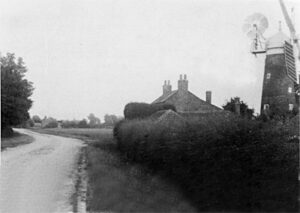
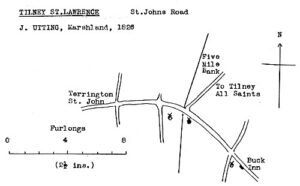
Tilney St Lawrence Tower Mill – Built c 1806 – Dismantled c 1925
|
To be Sold by Auction By WM. PATRICK On Friday 12 June 1807 at 4 o’c At the sign of the Woolpack in Terrington St. Johns, in the county of Norfolk. |
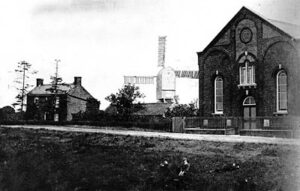
Tilney St Lawrence Fen End Postmill – Built c 1837 – c 1908 struck by lightning
|
Tilney St. Lawrence Fen End postmill stood close to the chapel on the south side of the village. The mill buck stood on a roundhouse and was turned to wind by a left handed 6 bladed fantail on the ladder, the original tailpole having been cut off. Power was supplied by four single shuttered patent sails – the inner pair had 6 bays of 4 shutters and the outer pair had 4 bays of 4 shutters and 3 bays of 3 shutters. Two pairs of stones were set in the breast of the mill, the left hand pair were French burr stones and the right hand pair were Peak stones. A bakehouse was run on the premises. |
|
Windmill at Tilney To be Let |
|
VIOLENT HURRICANE |
|
The Post Mill at Tilney Fen End which was owned by my Father was struck by lightning on Feb. 22nd in 1908 when my father was killed by lightning as my father was standing near the mill ready to aid the Fan tackle in case the wind changed. The Fan tackle travelled round the mill on a wood surface and if the wood was wet or slippery it was necessary to sprinkle ashes for the wheels to travel so that the Sails was kept Facing in the Wind. There were times when a very strong wind would cease for a brief Period and then blow from the opposite direction and that would cause the mill to be tailwinded that was why my Father was there to help and see that the Fan Tackle needed the ashes for the Fan Tackle to travel quickly. Then the lightning struck the mill and my Father was killed by the lightning. My brother Harry was up in the mill and came down in the mill but was not Hurt in any way. I was in the yard feeding the cows and the cows were so terrified they went round the yard in such a way indescrible. |
Did you know there was a pub called Victory Inn
Sid Briston, Jack Ketteringham, Lucy Kent & Jack Lewis c1930
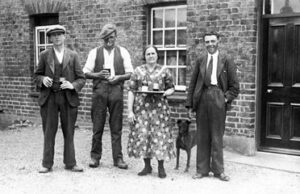
Edward Mason applied for a Spirit Licence Monday 6th September 1869. He had been running the house for 5 years. It was 65 yards away from the Buck Inn. The house was said to be well conducted and an important house, and scarcely to be classed with common beer shops. Application refused. ( And again, Monday, 2nd September 1872)
An application for a wine licence was refused Monday, 26th August 1878.
Advertise To Let, July 1915, with occupation from 11th October.
The tenant of 21 years about to leave.
Apply Steward & Patteson Ltd.
It was reported January 1926 that Mrs. L. E. Hancock of the Victory had collected £3 16s 5d in boxes, for the Norfolk and Lynn Hospital.
It was reported January 1929 that Mrs. Kent of the Victory had collected £4 16s in boxes for the Norfolk and Lynn Hospital.
In February 1930 she raised a further £4 15s 6d for the same cause.
On Saturday 3rd October 1931 the Furniture and Effects of the Victory Inn, the property of Mr. S. Hancock, were to be Sold, at 4:45 pm.
License of the (Lords) BRIDGE INN, Tilney cum Islington was removed to these premises 10th March 1952.
In May 1982 it was announced that the Victory was about to re-open following a closure of about 12 months. However, the event appears not to have occurred since the intended new licensees, John and Betty Edgeley arrived at the Tilney NEW INN in November 1982.
Demolished January 1983.
“Serious structural problems had been discovered during period of renovation in 1981-82.”
Planning sought for erection of three houses on the site.